NCSA Webboard
    • ล่าสุด
    • แท็ก
    • ฮิต
      • ติดต่อสำนักงาน
    • ลงทะเบียน
    • เข้าสู่ระบบ
    1. หน้าแรก
    2. NCSA_THAICERT
    • รายละเอียด
    • ติดตาม 0
    • คนติดตาม 2
    • กระทู้ 1,846
    • กระทู้ 1,847
    • ดีที่สุด 0
    • Controversial 0
    • กลุ่ม 2

    NCSA_THAICERT

    @NCSA_THAICERT

    1
    ชื่อเสียง
    48
    ดูข้อมูลส่วนตัว
    1.8k
    กระทู้
    2
    คนติดตาม
    0
    ติดตาม
    เข้าร่วม ออนไลน์ล่าสุด
    เว็บไซต์ www.ncsa.or.th/?fbclid=IwAR0BqJEC-CJzBs98rlBxUbZkNBgp1g814xdDNNaKnHTrxfqZhPD--ksY68I

    NCSA_THAICERT เลิกติดตาม ติดตาม
    Global Moderator administrators

    Latest posts made by NCSA_THAICERT

    • Cyber Threat Intelligence 28 January 2026

      Financial Sector

      • Investigation Into International “ATM Jackpotting” Scheme And Tren De Aragua Results In Additional Indictment And 87 Total Charged Defendants
        "A federal grand jury in the District of Nebraska returned an additional indictment charging 31 individuals for their roles in a large conspiracy to deploy malware and steal millions of dollars from ATMs in the United States, a crime commonly referred to as “ATM jackpotting.” Fifty-six others have already been charged. Many of the defendants charged in this Homeland Security Task Force operation are Venezuelan and Colombian nationals including illegal alien Tren de Aragua (TdA) members. This indictment alleges 32 counts including conspiracy to commit bank fraud, conspiracy to commit bank burglary and computer fraud, bank fraud, bank burglary, and damage to computers."
        https://www.justice.gov/opa/pr/investigation-international-atm-jackpotting-scheme-and-tren-de-aragua-results-additional
        https://therecord.media/dozens-more-charged-ploutus-jackpotting-atm
        https://www.bleepingcomputer.com/news/security/us-charges-31-more-suspects-linked-to-atm-malware-attacks/
        https://hackread.com/us-charges-atm-jackpotting-scam-suspects/

      Healthcare Sector

      • Report: Attacks 'Cascade' From IT, OT To Patient Care
        "Of the millions of threats detected in healthcare IT environments last year, email phishing, identity failures and device vulnerabilities were among the dominant vectors for non-clinical IT compromises - often "cascading" into patient care workflows and causing nearly $2 million a day in losses, said a new report from security firm Trellix. Of 54.7 million threats detected by Trellix last year across its healthcare customers worldwide, 75% originated at U.S.-based organizations, with email incidents - including phishing - accounting for at least 85% of the detections, Trellix said."
        https://www.bankinfosecurity.com/report-attacks-cascade-from-it-ot-to-patient-care-a-30608
        https://www.trellix.com/assets/reports/trellix-healthcare-cybersecurity-threat-intelligence-report.pdf

      Vulnerabilities

      • Critical Sandbox Escape Flaw Found In Popular Vm2 NodeJS Library
        "A critical-severity vulnerability in the vm2 Node.js sandbox library, tracked as CVE-2026-22709, allows escaping the sandbox and executing arbitrary code on the underlying host system. The open-source vm2 library creates a secure context to allow users to execute untrusted JavaScript code that does not have access to the filesystem. vm2 has historically been seen in SaaS platforms that support user script execution, online code runners, chatbots, and open-source projects, being used in more than 200,000 projects on GitHub. The project was discontinued in 2023, though, due to repeated sandbox-escape vulnerabilities, and considered unsafe for running untrusted code."
        https://www.bleepingcomputer.com/news/security/critical-sandbox-escape-flaw-discovered-in-popular-vm2-nodejs-library/
      • Fortinet Blocks Exploited FortiCloud SSO Zero Day Until Patch Is Ready
        "Fortinet has confirmed a new, actively exploited critical FortiCloud single sign-on (SSO) authentication bypass vulnerability, tracked as CVE-2026-24858, and says it has mitigated the zero-day attacks by blocking FortiCloud SSO connections from devices running vulnerable firmware versions. The flaw allows attackers to abuse FortiCloud SSO to gain administrative access to FortiOS, FortiManager, and FortiAnalyzer devices registered to other customers, even when those devices were fully patched against a previously disclosed vulnerability."
        https://www.bleepingcomputer.com/news/security/fortinet-blocks-exploited-forticloud-sso-zero-day-until-patch-is-ready/
        https://fortiguard.fortinet.com/psirt/FG-IR-26-060
        https://www.helpnetsecurity.com/2026/01/28/fortinet-forticloud-sso-zero-day-vulnerability-cve-2026-24858/
      • Cellbreak: Grist’s Pyodide Sandbox Escape And The Data-At-Risk Blast Radius
        "One malicious formula can turn a spreadsheet into a Remote Code Execution (RCE) beachhead. This sandbox escape lets a formula author execute OS commands or run host‑runtime JavaScript, collapsing the boundary between “cell logic” and host execution. Grist‑Core is a modern relational spreadsheet and programmable alternative to Excel and Google Sheets. Teams use it to model business data, build lightweight apps, and automate workflows with Python formulas across tables and integrations."
        https://www.cyera.com/research-labs/cellbreak-grists-pyodide-sandbox-escape-and-the-data-at-risk-blast-radius
        https://www.infosecurity-magazine.com/news/pyodide-sandbox-escape-rce-grist/
      • CISA Adds Five Known Exploited Vulnerabilities To Catalog
        "CISA has added five new vulnerabilities to its Known Exploited Vulnerabilities (KEV) Catalog, based on evidence of active exploitation.
        CVE-2018-14634 Linux Kernel Integer Overflow Vulnerability
        CVE-2025-52691 SmarterTools SmarterMail Unrestricted Upload of File with Dangerous Type Vulnerability
        CVE-2026-21509 Microsoft Office Security Feature Bypass Vulnerability
        CVE-2026-23760 SmarterTools SmarterMail Authentication Bypass Using an Alternate Path or Channel Vulnerability
        CVE-2026-24061 GNU InetUtils Argument Injection Vulnerability"
        https://www.cisa.gov/news-events/alerts/2026/01/26/cisa-adds-five-known-exploited-vulnerabilities-catalog
        https://securityaffairs.com/187375/security/u-s-cisa-adds-microsoft-office-gnu-inetutils-smartertools-smartermail-and-linux-kernel-flaws-to-its-known-exploited-vulnerabilities-catalog.html
        https://www.securityweek.com/organizations-warned-of-exploited-linux-vulnerabilities/
      • Over 6,000 SmarterMail Servers Exposed To Automated Hijacking Attacks
        "Nonprofit security organization Shadowserver has found over 6,000 SmarterMail servers exposed online and likely vulnerable to attacks exploiting a critical authentication bypass vulnerability. Cybersecurity company watchTowr reported the security flaw to developer SmarterTools on January 8, which released a fix on January 15 without assigning an identifier. The vulnerability was later assigned CVE-2026-23760 and rated critical severity, as it allows unauthenticated attackers to hijack admin accounts and gain remote code execution on the host, enabling them to take control of vulnerable servers."
        https://www.bleepingcomputer.com/news/security/over-6-000-smartermail-servers-exposed-to-automated-hijacking-attacks/
        https://securityaffairs.com/187394/hacking/shadowserver-finds-6000-likely-vulnerable-smartermail-servers-exposed-online.html
      • OpenSSL Security Advisory (corrected - Added CVE-2026-22795 And CVE-2026-22796)
        "Issue summary: Parsing CMS AuthEnvelopedData message with maliciously crafted AEAD parameters can trigger a stack buffer overflow. Impact summary: A stack buffer overflow may lead to a crash, causing Denial of Service, or potentially remote code execution. When parsing CMS AuthEnvelopedData structures that use AEAD ciphers such as AES-GCM, the IV (Initialization Vector) encoded in the ASN.1 parameters is copied into a fixed-size stack buffer without verifying that its length fits the destination. An attacker can supply a crafted CMS message with an oversized IV, causing a stack-based out-of-bounds write before any authentication or tag verification occurs."
        https://groups.google.com/a/openssl.org/g/openssl-project/c/pwBoo9Tac6M

      Malware

      • Diverse Threat Actors Exploiting Critical WinRAR Vulnerability CVE-2025-8088
        "The Google Threat Intelligence Group (GTIG) has identified widespread, active exploitation of the critical vulnerability CVE-2025-8088 in WinRAR, a popular file archiver tool for Windows, to establish initial access and deliver diverse payloads. Discovered and patched in July 2025, government-backed threat actors linked to Russia and China as well as financially motivated threat actors continue to exploit this n-day across disparate operations. The consistent exploitation method, a path traversal flaw allowing files to be dropped into the Windows Startup folder for persistence, underscores a defensive gap in fundamental application security and user awareness."
        https://cloud.google.com/blog/topics/threat-intelligence/exploiting-critical-winrar-vulnerability
        https://www.bleepingcomputer.com/news/security/winrar-path-traversal-flaw-still-exploited-by-numerous-hackers/
        https://cyberscoop.com/winrar-defect-active-exploits-google-threat-intel/
      • HoneyMyte Updates CoolClient And Deploys Multiple Stealers In Recent Campaigns
        "Over the past few years, we’ve been observing and monitoring the espionage activities of HoneyMyte (aka Mustang Panda or Bronze President) within Asia and Europe, with the Southeast Asia region being the most affected. The primary targets of most of the group’s campaigns were government entities. As an APT group, HoneyMyte uses a variety of sophisticated tools to achieve its goals. These tools include ToneShell, PlugX, Qreverse and CoolClient backdoors, Tonedisk and SnakeDisk USB worms, among others. In 2025, we observed HoneyMyte updating its toolset by enhancing the CoolClient backdoor with new features, deploying several variants of a browser login data stealer, and using multiple scripts designed for data theft and reconnaissance."
        https://securelist.com/honeymyte-updates-coolclient-uses-browser-stealers-and-scripts/118664/
        https://www.bleepingcomputer.com/news/security/chinese-mustang-panda-hackers-deploy-infostealers-via-coolclient-backdoor/
      • Alert: Sicarii Ransomware Encryption Key Handling Defect
        "Sicarii ransomware operations have been observed using an encryption process that can render post-payment data recovery impossible, even if a decryptor is provided. Halcyon malware analysts were the first to observe that the Sicarii binary includes a functional RSA implementation, but it is used in a way that undermines recoverability. During execution, the malware regenerates a new RSA key pair locally, uses the newly generated key material for encryption, and then discards the private key. This per-execution key generation means encryption is not tied to a recoverable master key, leaving victims without a viable decryption path and making attacker-provided decryptors ineffective for affected systems. Halcyon assesses with moderate confidence that the developers may have used AI-assisted tooling, which could have contributed to this implementation error. Organizations impacted by Sicarii ransomware should assume that ransom payment will not result in successful data restoration unless there is independent confirmation that this defect has been corrected."
        https://www.halcyon.ai/ransomware-alerts/alert-sicarii-ransomware-encryption-key-handling-defect
        https://www.darkreading.com/endpoint-security/vibe-coded-sicarii-ransomware-decrypted
      • How We Discovered A Campaign Of 16 Malicious Extensions Built To Steal ChatGPT Accounts
        "LayerX Research identified a coordinated set of Chrome browser extensions marketed as ChatGPT enhancement and productivity tools. In practice, however, these extensions are meant to steal users’ ChatGPT identities. The campaign consists of at least 16 distinct extensions developed by the same threat actor, in order to reach as wide a distribution as possible. This campaign coincides with a broader trend: the rapid growth in adoption of AI-powered browser extensions, aimed at helping users with their everyday productivity needs."
        https://layerxsecurity.com/blog/how-we-discovered-a-campaign-of-16-malicious-extensions-chatgpt/
        https://hackread.com/fake-chatgpt-extensions-hijack-user-accounts/
        https://www.securityweek.com/chrome-edge-extensions-caught-stealing-chatgpt-sessions/
      • APT Attacks Target Indian Government Using SHEETCREEP, FIREPOWER, And MAILCREEP | Part 2
        "In September 2025, Zscaler ThreatLabz uncovered three additional backdoors, SHEETCREEP, FIREPOWER, and MAILCREEP, used to power the Sheet Attack campaign. In Part 2 of this series, ThreatLabz will delve into these backdoors and analyze how threat actors are leveraging generative AI in their malware development processes. The Sheet Attack campaign stands out for its use of Google Sheets as a command-and-control (C2) channel, an uncommon tactic in this region. Between November 2025 and January 2026, ThreatLabz observed the deployment of new tools, including SHEETCREEP and FIREPOWER, along with MAILCREEP, which is used to manipulate emails, and a PowerShell-based document stealer to exfiltrate files."
        https://www.zscaler.com/blogs/security-research/apt-attacks-target-indian-government-using-sheetcreep-firepower-and
      • Dark Web Profile: BravoX Ransomware
        "BravoX is an emerging Ransomware-as-a-Service (RaaS) operation that surfaced after the publication of a new TOR-based data leak site (DLS) following a forum post on the RAMP underground forum. First observed in January 2026, the group currently operates at low volume, listing a limited number of victims while actively advertising an affiliate-driven model aimed at scaling its operations."
        https://socradar.io/blog/dark-web-profile-bravox-ransomware/

      Breaches/Hacks/Leaks

      • SoundCloud Data Breach
        "In December 2025, SoundCloud announced it had discovered unauthorised activity on its platform. The incident allowed an attacker to map publicly available SoundCloud profile data to email addresses for approximately 20% of its users. The impacted data included 30M unique email addresses, names, usernames, avatars, follower and following counts and, in some cases, the user’s country. The attackers later attempted to extort SoundCloud before publicly releasing the data the following month."
        https://haveibeenpwned.com/Breach/SoundCloud
        https://www.bleepingcomputer.com/news/security/have-i-been-pwned-soundcloud-data-breach-impacts-298-million-accounts/
      • Russian Security Systems Firm Delta Hit By Cyberattack, Services Disrupted
        "A cyberattack has disrupted operations at Delta, a Russian provider of alarm and security systems for homes, businesses and vehicles, causing widespread service outages and a wave of customer complaints. Delta said on Monday that it had been hit by a “large-scale, coordinated and well-organized” cyberattack that originated from an unspecified “hostile foreign state.” The company acknowledged temporary disruptions to some services but said there was no evidence that customers’ personal data had been compromised."
        https://therecord.media/russia-delta-security-alarm-company-cyberattack
      • Nova Ransomware Claims Breach Of KPMG Netherlands
        "KPMG Netherlands has allegedly become the latest target of the Nova ransomware group, following claims that sensitive data was accessed and exfiltrated. The incident was reported by ransomware monitoring services on 23 January 2026, with attackers claiming the breach occurred on the same day. Nova has reportedly issued a ten-day deadline for contact and ransom negotiations, a tactic commonly used by ransomware groups to pressure large organisations."
        https://dig.watch/updates/nova-ransomware-claims-breach-of-kpmg-netherlands

      General News

      • When Open Science Meets Real-World Cybersecurity
        "Scientific research environments are built for openness and collaboration, often prioritizing long-term discovery over traditional enterprise security. In this Help Net Security interview, Matthew Kwiatkowski, CISO at Fermilab, America’s particle physics and accelerator laboratory, discusses where cybersecurity blind spots emerge, why availability can outweigh confidentiality, and how security teams protect complex, legacy-driven research infrastructure while supporting scientific progress."
        https://www.helpnetsecurity.com/2026/01/27/matthew-kwiatkowski-fermilab-research-cybersecurity-challenges/
      • Waiting For AI Superintelligence? Don’t Hold Your Breath
        "AI’s impact on systems, security, and decision-making is already permanent. Superintelligence, often referred to as artificial superintelligence (ASI), describes a theoretical stage in which AI capability exceeds human cognitive performance across domains. Whether current systems are progressing toward cybersecurity superintelligence remains uncertain."
        https://www.helpnetsecurity.com/2026/01/27/cybersecurity-superintelligence-ai-future/
      • AI’s Appetite For Data Is Testing Enterprise Guardrails
        "Privacy programs are taking on more operational responsibility across the enterprise. A new Cisco global benchmark study shows expanding mandates, rising investment, and sustained pressure around data quality, accountability, and cross-border data management tied to AI systems. AI projects expanded the scope of privacy work across most enterprises over the past year. Budgets followed that shift, with additional spending planned as AI moves from pilots into production systems."
        https://www.helpnetsecurity.com/2026/01/27/cisco-ai-expands-privacy-programs/
      • AI & The Death Of Accuracy: What It Means For Zero-Trust
        "The glut of AI-generated content could introduce risks to large language models (LLMs) as AI tools begin to train on themselves. Gartner on Jan. 21 predicted that, by 2028, 50% of organizations will implement a zero-trust data governance posture due to an increase in what the analyst firm calls "unverified AI-generated data." Gartner dubbed the idea "model collapse," where machine-learning models could degrade based on errors introduced when they train on AI-generated content. That, in turn, could prompt a new security practice area related to zero-trust: continuous model behavior evaluation."
        https://www.darkreading.com/application-security/ai-death-accuracy-zero-trust
      • Beauty In Destruction: Exploring Malware's Impact Through Art
        "An eye-catching giant heart dangles from the ceiling in the lobby of Finnish security company WithSecure. The heart is crafted from 728 computer mice, crowdsourced from around the world, and each one is painted pink. The "Click for Love" art installation is the work of two artists, Hugo Lankinen and Kasper Hildén, who conceived of a pixelated heart in which each mouse acted as a 3D pixel."
        https://www.darkreading.com/vulnerabilities-threats/beauty-in-destruction-exploring-malware-impact-through-art
      • Hand CVE Over To The Private Sector
        "The Common Vulnerability Enumeration (CVE), now dubbed Common Vulnerabilities and Exposures, was created in 1999 to fill a void that never really existed to begin with. The CVE initiative was born out of a white paper titled "Towards a Common Enumeration of Vulnerabilities," written by David Mann and Steve Christey-Coley. The gist of the paper described the need for a "common enumeration" of vulnerabilities. However, it overlooks that there was already a broad coverage public vulnerability database (VDB) that had existed for more than a year."
        https://www.darkreading.com/cybersecurity-operations/hand-cve-over-to-private-sector
      • Over 80% Of Ethical Hackers Now Use AI
        "The vast majority (82%) of ethical hackers now use AI in their workflows, enabling companies to benefit from faster findings, more assessments, broader security coverage and higher quality reporting, according to Bugcrowd. The bug bounty specialist polled 2000 security researchers worldwide to compile its Inside the Mind of a Hacker report. It revealed a sharp jump in the share of respondents using AI, up from 64% in 2023. Three-quarters (74%) now believe AI increases the value of their work, virtually unchanged from last year."
        https://www.infosecurity-magazine.com/news/over-80-of-ethical-hackers-now-use/
      • Cyber Insights 2026: Quantum Computing And The Potential Synergy With Advanced AI
        "It’s hard not to have a dystopian view on the long term future effect of powerful quantum computers wedded to advanced artificial intelligence. But at least we have a few years to prepare. Quantum computers are coming, with a potential computing power almost beyond comprehension. That’s a given. The known threat is to current public key encryption methods, such as RSA and ECC, which will both be crackable through Shor’s algorithm in short timeframes. It is believed that nation states and advanced criminal gangs are engaged in a widespread harvest now, decrypt later (HNDL) campaign – steal and store data and secrets today, even if they are encrypted, because they can be decrypted later with quantum computers."
        https://www.securityweek.com/cyber-insights-2026-quantum-computing-and-the-potential-synergy-with-advanced-ai/
      • China Hacked Downing Street Phones For Years
        "China hacked the mobile phones of senior officials in Downing Street for several years, The Telegraph can disclose. The spying operation is understood to have compromised senior members of the government, exposing their private communications to Beijing. State-sponsored hackers are known to have targeted the phones of some of the closest aides to Boris Johnson, Liz Truss and Rishi Sunak between 2021 and 2024."
        https://www.telegraph.co.uk/news/2026/01/26/china-hacked-downing-street-phones-for-years/
        https://www.theregister.com/2026/01/27/chinalinked_hackers_accused_of_yearslong/
      • Why Has Microsoft Been Routing Example.com Traffic To a Company In Japan?
        "From the Department of Bizarre Anomalies: Microsoft has suppressed an unexplained anomaly on its network that was routing traffic destined to example.com—a domain reserved for testing purposes—to a maker of electronics cables located in Japan. Under the RFC2606—an official standard maintained by the Internet Engineering Task Force—example.com isn’t obtainable by any party. Instead it resolves to IP addresses assigned to Internet Assiged Names Authority. The designation is intended to prevent third parties from being bombarded with traffic when developers, penetration testers, and others need a domain for testing or discussing technical issues. Instead of naming an Internet-routable domain, they are to choose example.com or two others, example.net and example.org."
        https://arstechnica.com/information-technology/2026/01/odd-anomaly-caused-microsofts-network-to-mishandle-example-com-traffic/

      อ้างอิง
      Electronic Transactions Development Agency (ETDA) 89c65e47-0668-4a51-90a9-6deb5f9fef39-image.png

      โพสต์ใน Cyber Security News
      NCSA_THAICERTN
      NCSA_THAICERT
    • Cyber Threat Intelligence 27 January 2026

      New Tooling

      • Brakeman: Open-Source Vulnerability Scanner For Ruby On Rails Applications
        "Brakeman is an open-source security scanner used by teams that build applications with Ruby on Rails. The tool focuses on application code and configuration, giving developers and security teams a way to identify common classes of web application risk during development and testing. Brakeman analyzes application source code directly, including controllers, models, views, and templates. The scanner builds an internal representation of how data moves through the application, which allows it to flag patterns associated with security issues."
        https://www.helpnetsecurity.com/2026/01/26/brakeman-open-source-vulnerability-scanner-ruby-on-rails/
        https://github.com/presidentbeef/brakeman

      Vulnerabilities

      • Microsoft Patches Actively Exploited Office Zero-Day Vulnerability
        "Microsoft has released emergency out-of-band security updates to patch a high-severity Microsoft Office zero-day vulnerability exploited in attacks. The security feature bypass vulnerability, tracked as CVE-2026-21509, affects multiple Office versions, including Microsoft Office 2016, Microsoft Office 2019, Microsoft Office LTSC 2021, Microsoft Office LTSC 2024, and Microsoft 365 Apps for Enterprise (the company's cloud-based subscription service). However, as noted in today's advisory, security updates for Microsoft Office 2016 and 2019 are not yet available and will be released as soon as possible."
        https://www.bleepingcomputer.com/news/microsoft/microsoft-patches-actively-exploited-office-zero-day-vulnerability/
        https://msrc.microsoft.com/update-guide/vulnerability/CVE-2026-21509
        https://securityaffairs.com/187349/hacking/emergency-microsoft-update-fixes-in-the-wild-office-zero-day.html
      • Nearly 800,000 Telnet Servers Exposed To Remote Attacks
        "Internet security watchdog Shadowserver tracks nearly 800,000 IP addresses with Telnet fingerprints amid ongoing attacks exploiting a critical authentication bypass vulnerability in the GNU InetUtils telnetd server. The security flaw (CVE-2026-24061) impacts GNU InetUtils versions 1.9.3 (released 11 years ago in 2015) through 2.7 and was patched in version 2.8 (released on January 20). "The telnetd server invokes /usr/bin/login (normally running as root) passing the value of the USER environment variable received from the client as the last parameter," explained open-source contributor Simon Josefsson, who reported it."
        https://www.bleepingcomputer.com/news/security/nearly-800-000-telnet-servers-exposed-to-remote-attacks/
      • Hands-Free Lockpicking: Critical Vulnerabilities In Dormakaba’s Physical Access Control System
        "In this post, Clemens Stockenreitner and Werner Schober of the SEC Consult Vulnerability Lab highlight several critical vulnerabilities found in dormakaba’s physical access control systems based on exos 9300. This access control system originates from the manufacturer's enterprise product line for door and access systems and is predominantly used by large enterprises in Europe, including industrial and service companies, logistics operators, energy providers, and airport operators. It controls access to public and restricted areas, typically in combination with key cards (RFID) or fingerprint readers. According to the manufacturer, several thousand customers were affected, a small proportion of whom operate in environments with high security requirements."
        https://sec-consult.com/blog/detail/hands-free-lockpicking-critical-vulnerabilities-in-dormakabas-physical-access-control-system/
        https://www.securityweek.com/access-system-flaws-enabled-hackers-to-unlock-doors-at-major-european-firms/

      Malware

      • Novel Fake CAPTCHA Chain Delivering Amatera Stealer
        "The Blackpoint SOC has identified a new Fake CAPTCHA campaign that leverages a signed Microsoft Application Virtualization (App-V)1 script, SyncAppvPublishingServer.vbs, as a LOLBIN to proxy execution through a legitimate Windows component. Instead of launching PowerShell directly, the attacker uses this script to control how execution begins and to avoid more common, easily recognized execution paths. Early stages are designed to validate execution order and user behavior rather than exploit a vulnerability. Progression is gated on conditions established during the initial interaction, and when those expectations are not met, execution quietly stalls. This reinforces that the delivery flow itself is a core part of the attack, not just a means to reach the final payload."
        https://blackpointcyber.com/blog/novel-fake-captcha-chain-delivering-amatera-stealer/
        https://www.bleepingcomputer.com/news/security/new-clickfix-attacks-abuse-windows-app-v-scripts-to-push-malware/
        https://hackread.com/fake-captcha-scam-microsoft-tools-amatera-stealer/
      • Stanley — A $6,000 Russian Malware Toolkit With Chrome Web Store Guarantee
        "Browser-based attacks have entered a new phase, one that's more aggressive, more coordinated, and more dangerous than what we saw a few months ago. An attack vector once considered low-impact has become a huge threat targeting millions of online users. In December 2025, DarkSpectre exposed gaps in browser security by compromising 8.8 million Chrome, Edge, and Firefox users through three linked campaigns. January 2026 brought another concern: two extensions with a combined 900,000 installations were caught quietly siphoning ChatGPT and DeepSeek conversations, one of which carried Google's "Featured" badge. Around the same time, the CrashFix campaign manipulated users into installing a remote access trojan by intentionally crashing their browsers and posing as the solution."
        https://www.varonis.com/blog/stanley-malware-kit
        https://www.bleepingcomputer.com/news/security/new-malware-service-guarantees-phishing-extensions-on-chrome-web-store/
        https://hackread.com/stanley-toolkit-russia-forum-fakes-chrome-urls/
        https://www.securityweek.com/stanley-malware-toolkit-enables-phishing-via-website-spoofing/
      • PackageGate: 6 Zero-Days In JS Package Managers But NPM Won't Act
        "After Shai-Hulud ripped through npm last November (700+ packages compromised, 25,000 repos exposed) the ecosystem settled on a defense playbook: disable lifecycle scripts, and commit your lockfiles. It became the standard advice everywhere from GitHub security guides to corporate policy docs. Makes sense. If malicious code can't run on install, and your dependency tree is pinned, you're covered. Right?"
        https://www.koi.ai/blog/packagegate-6-zero-days-in-js-package-managers-but-npm-wont-act
        https://www.bleepingcomputer.com/news/security/hackers-can-bypass-npms-shai-hulud-defenses-via-git-dependencies/
      • APT Attacks Target Indian Government Using GOGITTER, GITSHELLPAD, And GOSHELL | Part 1
        "In September 2025, Zscaler ThreatLabz identified two campaigns, tracked as Gopher Strike and Sheet Attack, by a threat actor that operates in Pakistan and primarily targets entities in the Indian government. In both campaigns, ThreatLabz identified previously undocumented tools, techniques, and procedures (TTPs). While these campaigns share some similarities with the Pakistan-linked Advanced Persistent Threat (APT) group, APT36, we assess with medium confidence that the activity identified during this analysis might originate from a new subgroup or another Pakistan-linked group operating in parallel."
        https://www.zscaler.com/blogs/security-research/apt-attacks-target-indian-government-using-gogitter-gitshellpad-and-goshell
      • Weaponized In China, Deployed In India: The SyncFuture Espionage Targeted Campaign
        "In early December 2025, the eSentire Threat Response Unit (TRU) identified an ongoing campaign deploying a sophisticated, multi-stage backdoor for the likely purpose of long-term espionage. The campaign targets residents of India with phishing emails that impersonate the Income Tax Department of India, luring victims into downloading a malicious archive. The threat actor's primary objective is to gain persistent, elevated access to the victim's machine for continuous monitoring of user activities, file operations, and exfiltration of sensitive information."
        https://www.esentire.com/blog/weaponized-in-china-deployed-in-india-the-syncfuture-espionage-targeted-campaign
        https://thehackernews.com/2026/01/indian-users-targeted-in-tax-phishing.html
      • Special Alert: SLSH Malicious "Supergroup" Targeting 100+ Organizations Via Live Phishing Panels
        "A massive identity-theft campaign is currently active, targeting Okta Single Sign-On (SSO) and other SSO platform accounts across 100+ high-value enterprises. Silent Push has identified a surge in infrastructure deployment that mirrors the TTPs (Tactics, Techniques, and Procedures) of SLSH—a predatory alliance between Scattered Spider, LAPSUS$, and ShinyHunters. This isn’t a standard automated spray-and-pray attack; it is a human-led, high-interaction voice phishing (“vishing”) operation designed to bypass even hardened Multi-Factor Authentication (MFA) setups."
        https://www.silentpush.com/blog/slsh-alert/
        https://www.theregister.com/2026/01/26/shinyhunters_okta_sso_campaign/
      • PeckBirdy: A Versatile Script Framework For LOLBins Exploitation Used By China-Aligned Threat Groups
        "Since 2023, we have been observing threat campaigns employing a previously unseen script-based command-and-control (C&C) framework which we named PeckBirdy, being used against Chinese gambling industries, as well as malicious activities targeting Asian government entities and private organizations. While tracking this framework, we identified at least two campaigns using PeckBirdy, which we were able to link to several China-aligned advanced persistent threat (APT) actors. Note that we’ve previously discussed these campaigns during the HitCon conference last August 2025, and are now publishing this entry to share our findings to a wider audience."
        https://www.trendmicro.com/en_us/research/26/a/peckbirdy-script-framework.html
      • eScan Antivirus Supply Chain Breach Delivers Signed Malware
        "A critical supply chain compromise affecting MicroWorld Technologies’ eScan antivirus product was identified on January 20 2026, after malicious updates were reportedly delivered through the vendor’s legitimate update infrastructure. The incident led to the global distribution of multi-stage malware to enterprise and consumer endpoints, according to findings published today from Morphisec Threat Labs. The malicious packages were allegedly digitally signed using a compromised eScan certificate, allowing them to appear legitimate and bypass standard trust mechanisms. Once deployed, the malware established persistence, enabled remote access capabilities and actively prevented affected systems from receiving further updates."
        https://www.infosecurity-magazine.com/news/escan-antivirus-breach-delivers/
      • SEO Poisoning Marketplace Topping Search Results, Impersonating Top Financial Institutions
        "Fortra Intelligence and Research Experts (FIRE) have uncovered a group of active malicious threat actors operating since 2020. The group refers to themselves as Haxor, a slang word for hackers, and their marketplace as HxSEO, or HaxorSEO. HxSEO has established its primary base of operations and marketplace on Telegram and WhatsApp. HxSEO stands out for their emphasis on unethical search engine optimization (SEO) techniques, selling a service that supports phishing campaigns by improving the perceived legitimacy of malicious pages. Their optimization is impressively successful, with FIRE identifying fraudulent login pages that rank higher than the legitimate pages of global financial institutions."
        https://www.fortra.com/blog/seo-poisoning-marketplace-topping-search-results-impersonating-top-financial-institutions
        https://www.infosecurity-magazine.com/news/researchers-haxor-seo-poisoning/
      • Detection Of Recent RMM Distribution Cases Using AhnLab EDR
        "AhnLab SEcurity intelligence Center (ASEC) has recently observed an increase in attack cases exploiting Remote Monitoring and Management (RMM) tools. Whereas attackers previously exploited remote control tools during the process of seizing control after initial penetration, they now increasingly leverage RMM tools even during the initial distribution phase across diverse attack scenarios. This article covers recently identified RMM exploitation cases and detection methods using AhnLab EDR."
        https://asec.ahnlab.com/en/92319/

      Breaches/Hacks/Leaks

      • FRESH BREACH — LENA HEALTH BREACH PREVIEW — FULL LEAK COMING SOON
        "Lena Health is a company the world will be better off without. To this end, we are working with a plaintiff attorney to contact the true victims of this breach, mostly patients of Lena’s main client, Houston Methodist Hospital, to 1) coördinate a class action against the company, and 2) pressure Houston Methodist to cease their usage of this terrible “digital helper” system."
        https://databreaches.net/2026/01/26/125824/?pk_campaign=feed&pk_kwd=125824

      General News

      • Rethinking Cybersecurity In a Platform World
        "For more than a decade, enterprise cybersecurity has relied on point solutions. Companies invested in separate tools - endpoint detection, firewalls, cloud security, and identity and access management - each designed to address a specific threat or compliance requirement. But that approach is starting to break down. One big reason? Scale. Most large enterprises juggle 40 to 70 different security tools. In a fast-moving business environment, that's not just overwhelming - it's becoming a real barrier to effective risk management."
        https://www.bankinfosecurity.com/blogs/rethinking-cybersecurity-in-platform-world-p-4035
      • Cyber Insights 2026: Threat Hunting In An Age Of Automation And AI
        "Threat hunting is the practice of finding threats within the system. It sits between external attack surface management (EASM), and the security operations center (SOC). EASM seeks to thwart attacks by protecting the interface between the network and the internet. If it fails, and an attacker gets into the system, threat hunting seeks to find and monitor the traces left by the adversary so the attack can be neutralized before damage can be done. SOC engineers take new threat hunter data and build new detection rules for the SIEM. That’s a theoretical representation – precise details vary between different organizations."
        https://www.securityweek.com/cyber-insights-2026-threat-hunting-in-an-age-of-automation-and-ai/
      • BreachForums Disclosure Surfaces Falling Out Among ShinyHunters Thieves
        "Sunlight is said to be the best disinfectant, so now that the real identities of hundreds of thousands of alleged cybercriminals have been revealed, it will be interesting to see how many wind up in prison. Earlier this month a disgruntled member of the cybercrime syndicate known as ShinyHunters decided to disclose detailed information on 323,986 users of an online BreachForums site where cybercriminals acquire tools and share tactics and techniques. Apparently upset about cyberattacks targeting organizations in France, a cybercriminal only identified as “James” decided the time had come to show his former compatriots that they are no longer able to anonymously launch cyberattacks."
        https://blog.barracuda.com/2026/01/26/breachforums-disclosure-shinyhunters

      อ้างอิง
      Electronic Transactions Development Agency (ETDA) 6ae44dbf-9e5d-43e7-a958-6864b282250f-image.png

      โพสต์ใน Cyber Security News
      NCSA_THAICERTN
      NCSA_THAICERT
    • Stanly ชุดเครื่องมือ MaaS สร้างส่วนขยาย Chrome อันตราย ปลอมเว็บฟิชชิง โดยไม่เปลี่ยน URL

      ee9ab363-c9ee-4263-acd4-b0066b7536cc-image.png Stanly ชุดเครื่องมือ MaaS สร้างส่วนขยาย Chrome อันตรา.png

      สามารถติดตามข่าวสารได้ที่ webboard หรือ Facebook NCSA Thailand dd9d8b2d-ac9a-4f31-80ce-7a9cdfc9bd12-image.png

      โพสต์ใน Cyber Security News
      NCSA_THAICERTN
      NCSA_THAICERT
    • Nike อยู่ระหว่างตรวจสอบเหตุข้อมูลรั่วไหล หลังกลุ่ม WorldLeaks อ้างขโมยข้อมูล

      5ab4e6cf-fc44-40ab-9ee6-c0cc447dc143-image.png Nike อยู่ระหว่างตรวจสอบเหตุข้อมูลรั่วไหล หล.png

      สามารถติดตามข่าวสารได้ที่ webboard หรือ Facebook NCSA Thailand 33f689e6-38cf-4b12-b0ad-167c11f75358-image.png

      โพสต์ใน Cyber Security News
      NCSA_THAICERTN
      NCSA_THAICERT
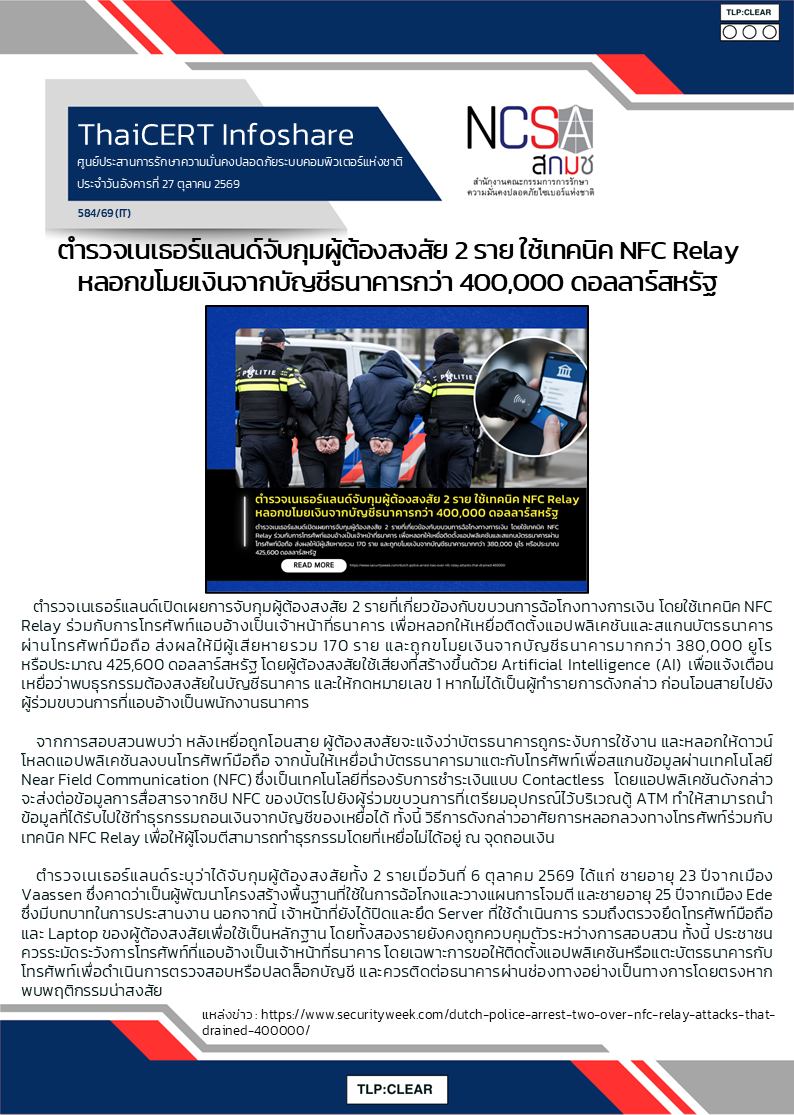
    • เฝ้าระวังกลุ่มแฮกเกอร์ Konni รุกหนัก ใช้ AI ช่วยเขียนมัลแวร์พุ่งเป้าเจาะระบบนักพัฒนา

      6a9411e0-01eb-45c5-be35-9a4294542ecd-image.png เฝ้าระวังกลุ่มแฮกเกอร์ Konni รุกหนัก ใช้ AI ช่ว.png

      สามารถติดตามข่าวสารได้ที่ webboard หรือ Facebook NCSA Thailand e4f65063-4437-4825-a903-e7596605818e-image.png
      โพสต์ใน Cyber Security News
      NCSA_THAICERTN
      NCSA_THAICERT
    • Cyber Threat Intelligence 26 January 2026

      Vulnerabilities

      • CISA Adds Four Known Exploited Vulnerabilities To Catalog
        "CISA has added four new vulnerabilities to its Known Exploited Vulnerabilities (KEV) Catalog, based on evidence of active exploitation.
        CVE-2025-31125 Vite Vitejs Improper Access Control Vulnerability
        CVE-2025-34026 Versa Concerto Improper Authentication Vulnerability
        CVE-2025-54313 Prettier eslint-config-prettier Embedded Malicious Code Vulnerability
        CVE-2025-68645 Synacor Zimbra Collaboration Suite (ZCS) PHP Remote File Inclusion Vulnerability"
        https://www.cisa.gov/news-events/alerts/2026/01/22/cisa-adds-four-known-exploited-vulnerabilities-catalog
        https://www.bleepingcomputer.com/news/security/cisa-confirms-active-exploitation-of-four-enterprise-software-bugs/
        https://thehackernews.com/2026/01/cisa-updates-kev-catalog-with-four.html
        https://securityaffairs.com/187241/security/u-s-cisa-adds-prettier-eslint-config-prettier-vite-vitejs-versa-concerto-sd-wan-orchestration-platform-and-synacor-zimbra-collaboration-suite-flaws-to-its-known-exploited-vulnerabilities-catal.html
        https://www.securityweek.com/organizations-warned-of-exploited-zimbra-collaboration-vulnerability/
      • CISA Adds One Known Exploited Vulnerability To Catalog
        "CISA has added one new vulnerability to its Known Exploited Vulnerabilities (KEV) Catalog, based on evidence of active exploitation.
        CVE-2024-37079 Broadcom VMware vCenter Server Out-of-bounds Write Vulnerability"
        https://www.cisa.gov/news-events/alerts/2026/01/23/cisa-adds-one-known-exploited-vulnerability-catalog
        https://www.theregister.com/2026/01/23/critical_vmware_vcenter_server_bug/
        https://thehackernews.com/2026/01/cisa-adds-actively-exploited-vmware.html
        https://securityaffairs.com/187267/security/u-s-cisa-adds-a-flaw-in-broadcom-vmware-vcenter-server-to-its-known-exploited-vulnerabilities-catalog.html

      Malware

      • MaliciousCorgi: The Cute-Looking AI Extensions Leaking Code From 1.5 Million Developers
        "AI coding assistants are everywhere. They suggest code, explain errors, write functions, review pull requests. Every developer marketplace is flooded with them - ChatGPT wrappers, Copilot alternatives, code completion tools promising to 10x your productivity. We install them without a second thought. They're in the official marketplace. They have thousands of reviews. They work. So we grant them access to our workspaces, our files, our keystrokes - and assume they're only using that access to help us code."
        https://www.koi.ai/blog/maliciouscorgi-the-cute-looking-ai-extensions-leaking-code-from-1-5-million-developers
        https://www.bleepingcomputer.com/news/security/malicious-ai-extensions-on-vscode-marketplace-steal-developer-data/
      • The Skeleton Key: How Attackers Weaponize Trusted RMM Tools For Backdoor Access
        "KnowBe4 Threat Labs recently examined a sophisticated dual-vector campaign that demonstrates the real-world exploitation chain following credential compromise. This is not a traditional virus attack. Instead of deploying custom viruses, attackers are bypassing security perimeters by weaponizing the necessary IT tools that administrators trust. By stealing a “skeleton key” to the system, they turn legitimate Remote Monitoring and Management (RMM) software into a persistent backdoor."
        https://blog.knowbe4.com/the-skeleton-key-how-attackers-weaponize-trusted-rmm-tools-for-backdoor-access
        https://thehackernews.com/2026/01/phishing-attack-uses-stolen-credentials.html
      • ESET Research: Sandworm Behind Cyberattack On Poland’s Power Grid In Late 2025
        "In late 2025, Poland’s energy system faced what has been described as the “largest cyberattack” targeting the country in years. ESET Research has now found that the attack was the work of the notorious Russia-aligned APT group Sandworm. “Based on our analysis of the malware and associated TTPs, we attribute the attack to the Russia-aligned Sandworm APT with medium confidence due to a strong overlap with numerous previous Sandworm wiper activity we analyzed,” said ESET researchers. “We’re not aware of any successful disruption occurring as a result of this attack,” they added."
        https://www.welivesecurity.com/en/eset-research/eset-research-sandworm-cyberattack-poland-power-grid-late-2025/
        https://thehackernews.com/2026/01/new-dynowiper-malware-used-in-attempted.html
        https://www.bleepingcomputer.com/news/security/sandworm-hackers-linked-to-failed-wiper-attack-on-polands-energy-systems/

      Breaches/Hacks/Leaks

      • ShinyHunters Claims Okta Customer Breaches, Leaks Data Belonging To 3 Orgs
        "ShinyHunters has claimed responsibility for an Okta voice-phishing campaign during which the extortionist crew allegedly gained access to Crunchbase and Betterment. On Friday, the criminals leaked data allegedly stolen from market-intel broker Crunchbase, streaming platform SoundCloud, and financial-tech firm Betterment, and confirmed to The Register that they gained access to two of the three - Crunchbase and Betterment - by voice-phishing Okta single-sign-on codes. SoundCloud in December confirmed it had been breached and the crooks accessed data belonging to about 20 percent of its users, which translates to about 28 million people, based on the company's publicly available customer count."
        https://www.theregister.com/2026/01/23/shinyhunters_claims_okta_customer_breaches/
        https://www.bleepingcomputer.com/news/security/shinyhunters-claim-to-be-behind-sso-account-data-theft-attacks/
        https://www.bankinfosecurity.com/voice-phishing-okta-customers-shinyhunters-claims-credit-a-30590
        https://hackread.com/shinyhunters-leak-soundcloud-crunchbase-betterment-data/
      • 149M Logins And Passwords Exposed Online Including Financial Accounts, Instagram, Facebook, Roblox, Dating Sites, And More.
        "Cybersecurity Researcher Jeremiah Fowler uncovered a data leak of 149 million logins and passwords, and shared his findings with ExpressVPN. We are publishing his report to help the public stay informed and protected as part of our ongoing effort to highlight important security risks. The publicly exposed database was not password-protected or encrypted. It contained 149,404,754 unique logins and passwords, totaling a massive 96 GB of raw credential data. In a limited sampling of the exposed documents, I saw thousands of files that included emails, usernames, passwords, and the URL links to the login or authorization for the accounts."
        https://www.expressvpn.com/blog/149m-infostealer-data-exposed/
        https://hackread.com/logins-roblox-tiktok-netflix-crypto-wallets-found/
      • Cyberattack Disrupts Digital Systems At Renowned Dresden Museum Network
        "Germany’s Dresden State Art Collections, one of Europe’s oldest museum networks, has been hit by a targeted cyberattack that disrupted large parts of its digital infrastructure, the state of Saxony’s culture ministry said this week. The attack, discovered on Wednesday, has left the museum group with limited digital and phone services. Online ticket sales, visitor services, and the museum shop are currently unavailable, and payments at museum sites can only be made in cash. Tickets purchased online before the incident remain valid and can still be scanned on site."
        https://therecord.media/dresden-state-art-collections-cyberattack
      • Nike Probing Potential Security Incident As Hackers Threaten To Leak Data
        "Nike has launched an investigation after a cybercrime group claimed to have stolen data from its systems. The athletic footwear and apparel giant was listed as a victim on the Tor-based leak website operated by the WorldLeaks gang on January 22, and a timer indicates that the stolen data will be made public on January 24, unless a ransom is paid. The cybercriminals have not specified how much or what type of data they allegedly stole from Nike."
        https://www.securityweek.com/nike-probing-potential-security-incident-as-hackers-threaten-to-leak-data/
        https://securityaffairs.com/187303/data-breach/nike-is-investigating-a-possible-data-breach-after-worldleaks-claims.html

      General News

      • Hackers Get $1,047,000 For 76 Zero-Days At Pwn2Own Automotive 2026
        "Pwn2Own Automotive 2026 has ended with security researchers earning $1,047,000 after exploiting 76 zero-day vulnerabilities between January 21 and January 23. The Pwn2Own Automotive hacking competition focuses on automotive technologies and took place this week in Tokyo, Japan, during the Automotive World auto conference. Throughout the contest, the hackers targeted fully patched in-vehicle infotainment (IVI) systems, electric vehicle (EV) chargers, and car operating systems (e.g., Automotive Grade Linux)."
        https://www.bleepingcomputer.com/news/security/hackers-get-1-047-000-for-76-zero-days-at-pwn2own-automotive-2026/
        https://www.darkreading.com/endpoint-security/researchers-find-new-ways-hack-vehicles
        https://www.securityweek.com/infotainment-ev-charger-exploits-earn-hackers-1m-at-pwn2own-automotive-2026/
        https://www.theregister.com/2026/01/25/pwn2own_automotive_2026_identifies_76_0days/
      • Healthy Security Cultures Thrive On Risk Reporting
        "Businesses can either fear risk or celebrate it. A growing number are embracing the latter. Many risk management styles thrive on fear – the fear of documenting risks, writing them down, and making them discoverable within the organization. Security professionals worry they'll be blamed for those risks, even if they don't amount to any real problems – and if they do lead to incidents or breaches that worry evolves into panic."
        https://www.darkreading.com/cyber-risk/healthy-security-cultures-thrive-on-risk-reporting
      • One-Time SMS Links That Never Expire Can Expose Personal Data For Years
        "Online services often treat one-time links sent by text message as low-risk conveniences. A new study shows that these links can expose large amounts of personal data for years. According to to Proofpoint, cybercriminals favor malicious URLs over attachments, as they are easier to disguise and more likely to evade detection. These links are embedded in messages, buttons, and even inside attachments like PDFs or Word documents to entice clicks that initiate credential phishing or malware downloads."
        https://www.helpnetsecurity.com/2026/01/23/sms-private-urls-data-exposure-study/
      • More Employees Get AI Tools, Fewer Rely On Them At Work
        "People across many organizations now have access to AI tools, and usage keeps spreading. Some groups rely on AI during regular work, others treat it as an occasional helper. That gap between access and routine use sits at the center of new research from Deloitte on enterprise AI adoption. The research draws on a global survey of more than 3,200 business and IT leaders conducted in late 2025. Respondents come from large organizations across industries and regions. Many report progress during the past year, especially around tool access and executive support. The findings also show friction around scaling, governance, and workforce readiness."
        https://www.helpnetsecurity.com/2026/01/23/deloitte-enterprise-ai-adoption/
      • Agentic AI Edges Closer To Everyday Production Use
        "Many security and operations teams now spend less time asking whether agentic AI belongs in production and more time working out how to run it safely at scale. A new Dynatrace research report looks at how large organizations are moving agentic AI from pilots into live environments and where those efforts are stalling. The report shows agentic AI already embedded in core operational functions, including IT operations, cybersecurity, data processing, and customer support. 70% of respondents say they use AI agents in IT operations and system monitoring, with nearly half running agentic AI across both internal and external use cases."
        https://www.helpnetsecurity.com/2026/01/23/cybersecurity-agentic-ai-operations/
      • Cyber Insights 2026: Regulations And The Tangled Mess Of Compliance Requirements
        "A Gordian Knot is a puzzle that cannot be unraveled, only destroyed. Our own Gordian Mess is an ever growing tangle of regulations that can be neither unraveled nor destroyed. Cyber regulations are where politics meets business – where business becomes subject to political realities. For the last few years, politics has been shaped by geopolitical tension. Different regions and countries have become more nationalist in both politics and attitudes. Even the EU, which has traditionally been ‘liberal’ is now better described as center-right. The overall effect of this global growth in nationalism is that different regions, countries and states are increasingly assertive about their own digital sovereignty."
        https://www.securityweek.com/cyber-insights-2026-regulations-and-the-tangled-mess-of-compliance-requirements/
      • 2025 Was a Wake-Up Call To Protect Human Decisions, Not Just Systems
        "As 2026 begins, I keep coming back to one uncomfortable realization about 2025. We did not misunderstand attackers. We misunderstood failure. Most of last year’s damage did not come from sophisticated techniques or unexpected adversaries. It came from ordinary systems breaking in ways that quietly altered how people made decisions. Systems stayed online. Dashboards stayed green. Confidence eroded, judgment shifted, and humans were forced to act without reliable truth. That is where the real harm happened."
        https://www.darkreading.com/cyber-risk/wake-up-call-to-protect-human-decisions-not-just-systems

      อ้างอิง
      Electronic Transactions Development Agency (ETDA) b6185b7d-382c-4874-b663-2fa47ca067b0-image.png

      โพสต์ใน Cyber Security News
      NCSA_THAICERTN
      NCSA_THAICERT
    • CISA เพิ่มช่องโหว่ VMware vCenter (CVE-2024-37079) ลงบัญชี KEV หลังพบการโจมตีจริง

      34983c1b-2beb-4401-9b28-fc900843abf1-image.png CISA เพิ่มช่องโหว่ VMware vCenter (CVE-2024-37079) ลงบัญชี KEV หลังพ.png

      สามารถติดตามข่าวสารได้ที่ webboard หรือ Facebook NCSA Thailand fea937e9-63ff-418c-ae3b-1058a31d344b-image.png

      โพสต์ใน Cyber Security News
      NCSA_THAICERTN
      NCSA_THAICERT
    • พบแรนซัมแวร์ Osiris สายพันธุ์ใหม่ ใช้เทคนิค BYOVD ปิดการทำงานเครื่องมือความปลอดภัย

      74d5d570-a883-4419-8a82-ff15f52431a2-image.png พบแรนซัมแวร์ Osiris สายพันธุ์ใหม่ ใช้เทคนิค BYOVD .png

      สามารถติดตามข่าวสารได้ที่ webboard หรือ Facebook NCSA Thailand 5b2ce1bc-0bfc-4f60-998c-6720f4de907c-image.png
      โพสต์ใน Cyber Security News
      NCSA_THAICERTN
      NCSA_THAICERT
    • พบกลุ่มแฮกเกอร์ Sandworm ทำการโจมตี ระบบโรงงานไฟฟ้าโปแลนด์ด้วยมัลแวร์ DynoWiper

      4ec27fcc-4a9a-4030-be24-17306cbffeb6-image.png พบกลุ่มแฮกเกอร์ Sandworm ทำการโจมตีระบบโรงงานไ.png

      สามารถติดตามข่าวสารได้ที่ webboard หรือ Facebook NCSA Thailand db7220de-7425-4810-88cf-2ae926f78da1-image.png

      โพสต์ใน Cyber Security News
      NCSA_THAICERTN
      NCSA_THAICERT
    • Cyber Threat Intelligence 23 January 2026

      Financial Sector

      • December 2025 Security Issues In Korean & Global Financial Sector
        "This report comprehensively covers real-world cyber threats and security issues that have occurred in the financial industry in Korea and worldwide. It includes an analysis of malware and phishing cases targeting the financial industry, a list of the top 10 malware strains targeting the industry, and statistics on the sectors of Korean accounts leaked on Telegram. A detailed analysis of a phishing email campaign targeting financial institutions is also included."
        https://asec.ahnlab.com/en/92207/

      Vulnerabilities

      • Critical Arbitrary File Upload Vulnerability In RealHomes CRM Plugin Affecting 30k+ Sites
        "This blog post is about a Subscriber+ arbitrary file upload vulnerability in the RealHomes CRM. If you're a RealHomes CRM user, please update to at least version 1.0.1."
        https://patchstack.com/articles/critical-arbitrary-file-upload-vulnerability-in-realhomes-crm-plugin-affecting-30k-sites/
        https://www.infosecurity-magazine.com/news/realhomes-crm-plugin-flaw/
      • Critical GNU InetUtils Telnetd Flaw Lets Attackers Bypass Login And Gain Root Access
        "A critical security flaw has been disclosed in the GNU InetUtils telnet daemon (telnetd) that went unnoticed for nearly 11 years. The vulnerability, tracked as CVE-2026-24061, is rated 9.8 out of 10.0 on the CVSS scoring system. It affects all versions of GNU InetUtils from version 1.9.3 up to and including version 2.7. "Telnetd in GNU Inetutils through 2.7 allows remote authentication bypass via a '-f root' value for the USER environment variable," according to a description of the flaw in the NIST National Vulnerability Database (NVD)."
        https://thehackernews.com/2026/01/critical-gnu-inetutils-telnetd-flaw.html
        https://www.theregister.com/2026/01/22/root_telnet_bug/
      • Foxit, Epic Games Store, MedDreams Vulnerabilities
        "Cisco Talos’ Vulnerability Discovery & Research team recently disclosed three vulnerabilities in Foxit PDF Editor, one in the Epic Games Store, and twenty-one in MedDream PACS.. The vulnerabilities mentioned in this blog post have been patched by their respective vendors, all in adherence to Cisco’s third-party vulnerability disclosure policy."
        https://blog.talosintelligence.com/foxi-and-epic-games/
      • CVE-2026-22794: Changing The Origin Header To Take Over Appsmith Accounts
        "Resecurity is tracking the exploitation of CVE-2026-22794, a critical authentication vulnerability in Appsmith that allows attackers to take over user accounts by manipulating the HTTP Origin header during the password reset process. The flaw occurs because Appsmith uses a client-controlled header to construct password reset links, exposing sensitive tokens. An attacker can request a password reset for a victim’s email while providing a malicious Origin (e.g., https://evil.com). The victim receives a legitimate email, but the link points to the attacker’s server. Clicking the link leaks the reset token, allowing the attacker to change the victim’s password and take full control of the account."
        https://www.resecurity.com/es/blog/article/cve-2026-22794-changing-the-origin-header-to-take-over-appsmith-accounts
        https://www.infosecurity-magazine.com/news/appsmith-flaw-account-takeovers/
      • CISA Adds One Known Exploited Vulnerability To Catalog
        "CISA has added one new vulnerability to its Known Exploited Vulnerabilities (KEV) Catalog, based on evidence of active exploitation.
        CVE-2026-20045 Cisco Unified Communications Products Code Injection Vulnerability"
        https://www.cisa.gov/news-events/alerts/2026/01/21/cisa-adds-one-known-exploited-vulnerability-catalog
        https://www.securityweek.com/hackers-targeting-cisco-unified-cm-zero-day/
        https://securityaffairs.com/187181/uncategorized/u-s-cisa-adds-a-flaw-in-cisco-unified-communications-products-to-its-known-exploited-vulnerabilities-catalog.html
      • Old Attack, New Speed: Researchers Optimize Page Cache Exploits
        "team of researchers from the Graz University of Technology (TU Graz) in Austria has revived Linux page cache attacks, demonstrating that they are not as impractical as previously believed. Page caches are designed to store file-backed memory pages, such as application binaries, libraries, and data files. By keeping a copy of recently accessed disk data in the system’s memory, the operating system can fulfill subsequent requests more quickly, significantly improving overall performance. Back in 2019, researchers from the Austrian university and several other organizations showed that Windows and Linux page caches can be abused for both local and remote attacks."
        https://www.securityweek.com/old-attack-new-speed-researchers-optimize-page-cache-exploits/
        https://snee.la/pdf/pubs/eviction-notice.pdf
      • An Open Source Tool To Unravel UEFI And Its Vulnerabilities
        "As recently as December 2025, the SEI’s CERT Coordination Center (CERT/CC) documented a UEFI-related vulnerability in certain motherboard models, illustrating that early-boot firmware behavior continues to present security challenges despite requiring local physical access to exploit. UEFI is a critical element of system firmware because it initializes hardware and boots up the operating system. Tampering with UEFI can support attacks that are particularly difficult to detect and mitigate."
        https://www.sei.cmu.edu/blog/an-open-source-tool-to-unravel-uefi-and-its-vulnerabilities/

      Malware

      • Arctic Wolf Observes Malicious Configuration Changes On Fortinet FortiGate Devices Via SSO Accounts
        "Starting on January 15, 2026, Arctic Wolf began observing a new cluster of automated malicious activity involving unauthorized firewall configuration changes on FortiGate devices. This activity involved the creation of generic accounts intended for persistence, configuration changes granting VPN access to those accounts, as well as exfiltration of firewall configurations. This is a developing situation, and we will share more technical details of this threat with the public as more information becomes available. While the parameters of initial access details have not been fully confirmed, the current campaign bears similarity to a campaign described by Arctic Wolf in December 2025. In the December security bulletin, we provided details of SSO login activity for administrator accounts, followed by configuration changes and exfiltration on affected firewall devices."
        https://arcticwolf.com/resources/blog/arctic-wolf-observes-malicious-configuration-changes-fortinet-fortigate-devices-via-sso-accounts/
        https://thehackernews.com/2026/01/automated-fortigate-attacks-exploit.html
        https://www.bleepingcomputer.com/news/security/hackers-breach-fortinet-fortigate-devices-steal-firewall-configs/
        https://www.darkreading.com/cloud-security/fortinet-firewalls-malicious-configuration-changes
        https://securityaffairs.com/187194/hacking/arctic-wolf-detects-surge-in-automated-fortinet-fortigate-firewall-configuration-attacks.html
        https://www.securityweek.com/new-wave-of-attacks-targeting-fortigate-firewalls/
        https://www.theregister.com/2026/01/22/fortigate_firewalls_hit_by_silent/
      • Phishing Kits Adapt To The Script Of Callers
        "Okta Threat Intelligence has detected and dissected multiple custom phishing kits that have evolved to meet the specific needs of voice-based social engineers (“callers”) in vishing campaigns. These custom kits are made available on an as-a-service basis and are increasingly used by a growing number of intrusion actors targeting Google, Microsoft, Okta and a range of cryptocurrency providers. The kits are capable of intercepting the credentials of targeted users, while also presenting the supporting context required to convince users to approve MFA challenges, or to take other actions in the interests of the attacker on the phone."
        https://www.okta.com/blog/threat-intelligence/phishing-kits-adapt-to-the-script-of-callers/
        https://www.bleepingcomputer.com/news/security/okta-sso-accounts-targeted-in-vishing-based-data-theft-attacks/
        https://www.theregister.com/2026/01/22/crims_sell_voice_phishing_kits/
      • Attackers With Decompilers Strike Again (SmarterTools SmarterMail WT-2026-0001 Auth Bypass)
        "Well, well, well - look what we’re back with. You may recall that merely two weeks ago, we analyzed CVE-2025-52691 - a pre-auth RCE vulnerability in the SmarterTools SmarterMail email solution with a timeline that is typically reserved for KEV hall-of-famers. The plot of that story had everything; A government agency, Vague patch notes (in our opinion), Fairly tense forum posts, and Accusations of in-the-wild exploitation. The sort of thing dreams are made of~"
        https://labs.watchtowr.com/attackers-with-decompilers-strike-again-smartertools-smartermail-wt-2026-0001-auth-bypass/
        https://thehackernews.com/2026/01/smartermail-auth-bypass-exploited-in.html
        https://www.bleepingcomputer.com/news/security/smartermail-auth-bypass-flaw-now-exploited-to-hijack-admin-accounts/
        https://securityaffairs.com/187201/hacking/critical-smartermail-vulnerability-under-attack-no-cve-yet.html
      • When Ransomware Makes a Mistake Inside INC Ransomware’s Backup Infrastructure
        "This article documents how Cyber Centaurs identified, validated, and safely accessed attacker-controlled data repositories operated by the INC Ransomware Group, resulting in the recovery of stolen data belonging to twelve unrelated U.S. corporations. What made this possible was not a vulnerability or a takedown, but forensic discipline applied to attacker tooling. Specifically, artifacts left behind from Restic, a legitimate backup utility repeatedly repurposed by INC in other campaigns, exposed a persistent layer of attacker infrastructure that extended well beyond a single victim environment."
        https://cybercentaurs.com/blog/when-ransomware-makes-a-mistake-inside-inc-ransomwares-backup-infrastructure/
        https://www.bleepingcomputer.com/news/security/inc-ransomware-opsec-fail-allowed-data-recovery-for-12-us-orgs/
      • AI-Powered North Korean Konni Malware Targets Developers
        "Check Point Research is tracking an active phishing campaign involving KONNI, a North Korea-affiliated threat actor active since at least 2014. Historically, KONNI focused on South Korean diplomatic, academic, and government-linked targets, using geopolitical themes as phishing lures. This latest activity marks a clear shift. In the current campaign, KONNI targets software developers and engineering teams, particularly those involved in blockchain and cryptocurrency projects."
        https://blog.checkpoint.com/research/ai-powered-north-korean-konni-malware-targets-developers/
      • Attackers Continue To Target Trusted Collaboration Platforms: 12,000+ Emails Target Teams Users
        "This report describes a phishing campaign in which attackers abuse Microsoft Teams functionality to distribute phishing content that appears to originate from legitimate Microsoft services. The attack leverages guest invitations and phishing-themed team names to impersonate billing and subscription notifications, encouraging victims to contact a fraudulent support phone number."
        https://blog.checkpoint.com/email-security/attackers-continue-to-target-trusted-collaboration-platforms-12000-emails-target-teams-users/
      • Darktrace Identifies Campaign Targeting South Korea Leveraging VS Code For Remote Access
        "Darktrace identified a DPRK‑linked campaign targeting South Korean users with JSE‑based spear‑phishing lures. The attackers used government‑themed decoy documents to deploy a VS Code tunnel, enabling covert remote access via trusted Microsoft infrastructure. The activity highlights growing abuse of legitimate tools to evade detection and maintain persistent access."
        https://www.darktrace.com/blog/darktrace-identifies-campaign-targeting-south-korea-leveraging-vs-code-for-remote-access
        https://www.darkreading.com/endpoint-security/dprk-vs-code-tunnels-remote-hacking
      • Analysis Of Single Sign-On Abuse On FortiOS
        "In December 2025, Fortinet issued an advisory related to two FortiCloud single sign-on (SSO) bypass vulnerabilities (CVE-2025-59718 and CVE-2025-59719) that the Fortinet product security team had internally discovered during a code audit (FG-IR-25-647). The vulnerabilities described in the advisory allowed for unauthenticated bypass of SSO login authentication via crafted SAML sent to FortiOS, FortiWeb, FortiProxy, and FortiSwitch Manager devices when the FortiCloud SSO feature was enabled."
        https://www.fortinet.com/blog/psirt-blogs/analysis-of-sso-abuse-on-fortios
      • VoidLink Threat Analysis: Sysdig Discovers C2-Compiled Kernel Rootkits
        "On January 13, 2026, Check Point Research published its analysis of VoidLink, a Chinese-developed Linux malware framework designed to target cloud environments. Following its discovery, the Sysdig Threat Research Team (TRT) took a deeper look at Voidlink, examining its binaries to better understand the malware’s loader chain, rootkit internals, and control mechanisms."
        https://www.sysdig.com/blog/voidlink-threat-analysis-sysdig-discovers-c2-compiled-kernel-rootkits
        https://hackread.com/voidlink-malware-cloud-system-custom-built-attack/
      • Resurgence Of a Multi‑stage AiTM Phishing And BEC Campaign Abusing SharePoint
        "Microsoft Defender Researchers uncovered a multi‑stage adversary‑in‑the‑middle (AiTM) phishing and business email compromise (BEC) campaign targeting multiple organizations in the energy sector, resulting in the compromise of various user accounts. The campaign abused SharePoint file‑sharing services to deliver phishing payloads and relied on inbox rule creation to maintain persistence and evade user awareness. The attack transitioned into a series of AiTM attacks and follow-on BEC activity spanning multiple organizations."
        https://www.microsoft.com/en-us/security/blog/2026/01/21/multistage-aitm-phishing-bec-campaign-abusing-sharepoint/
        https://www.helpnetsecurity.com/2026/01/22/energy-sector-aitm-phishing-sharepoint-misuse/
        https://www.theregister.com/2026/01/22/crims_compromised_energy_firms_microsoft/
      • Osiris: New Ransomware, Experienced Attackers?
        "A new ransomware family called Osiris was used in an attack targeting a major food service franchisee operator in Southeast Asia in November 2025. While this Osiris ransomware shares a name with a ransomware family from 2016, which was a variant of the Locky ransomware, there is no indication that there is any link between these two families. Investigation by the Symantec and Carbon Black Threat Hunter Team found that this threat is unique and appears to be a completely new ransomware family."
        https://www.security.com/threat-intelligence/new-ransomware-osiris
        https://thehackernews.com/2026/01/new-osiris-ransomware-emerges-as-new.html
      • PyPI Package Impersonates SymPy To Deliver Cryptomining Malware
        "Socket’s Threat Research Team identified a malicious PyPI package, sympy-dev, that impersonates SymPy, a widely used symbolic mathematics library with roughly 85 million downloads per month. The threat actor copied SymPy’s project description and branding cues into the sympy-dev listing, increasing the likelihood of accidental installation. PyPI shows four releases, versions 1.2.3 through 1.2.6, all containing malicious code and published on January 17, 2026, with Nanit listed as the maintainer. In its first day on PyPI, sympy-dev surpassed 1,000 downloads. Downloads do not equate to infections, but early uptake suggests the package began reaching real developer and CI environments quickly."
        https://socket.dev/blog/pypi-package-impersonates-sympy-to-deliver-cryptomining-malware
        https://thehackernews.com/2026/01/malicious-pypi-package-impersonates.html
      • From Protest To Peril: Cellebrite Used Against Jordanian Civil Society
        "Through a multi-year investigation, we find that the Jordanian security apparatus has deployed forensic extraction products manufactured by Cellebrite against civil society devices. We release these findings alongside reporting from the Organized Crime and Corruption Reporting Project (OCCRP) which includes interviews with a few of the victims."
        https://citizenlab.ca/research/from-protest-to-peril-cellebrite-used-against-jordanian-civil-society/
        https://therecord.media/jordan-used-cellebrite-against-activists-critical-gaza-war
      • Watering Hole Attack Targets EmEditor Users With Information-Stealing Malware
        "In late December 2025, EmEditor, a highly extensible and widely used text, code, and CSV editor developed by U.S.-based Emurasoft, published a security advisory warning users that its download page had been compromised. The attackers’ objective was to distribute a compromised version of the program to unsuspecting users. EmEditor has longstanding recognition within Japanese developer communities as a recommended Windows-based editor. This suggests that the attackers are targeting this specific user base, or that they have a particular target among EmEditor users and used the compromised download page as delivery mechanism."
        https://www.trendmicro.com/en_us/research/26/a/watering-hole-attack-targets-emeditor-users.html
      • The Next Frontier Of Runtime Assembly Attacks: Leveraging LLMs To Generate Phishing JavaScript In Real Time
        "Imagine visiting a webpage that looks perfectly safe. It has no malicious code, no suspicious links. Yet, within seconds, it transforms into a personalized phishing page. This isn't merely an illusion. It's the next frontier of web attacks where attackers use generative AI (GenAI) to build a threat that’s loaded after the victim has already visited a seemingly innocuous webpage."
        https://unit42.paloaltonetworks.com/real-time-malicious-javascript-through-llms/

      General News

      • Hackers Exploit 29 Zero-Days On Second Day Of Pwn2Own Automotive
        "On the second day of Pwn2Own Automotive 2026, security researchers collected $439,250 in cash awards after exploiting 29 unique zero-days. The Pwn2Own Automotive hacking contest focuses on automotive technologies and takes place this week in Tokyo, Japan, from January 21 to January 23, during the Automotive World auto conference. Throughout the competition, security researchers target fully patched electric vehicle (EV) chargers, in-vehicle infotainment (IVI) systems, and car operating systems (e.g., Automotive Grade Linux)."
        https://www.bleepingcomputer.com/news/security/hackers-exploit-29-zero-day-vulnerabilities-on-second-day-of-pwn2own-automotive/
      • AI Agents Undermine Progress In Browser Security
        "Browser security is far from perfect, but technologists and cybersecurity researchers have built a security model that, for the most part, works. However, artificial intelligence (AI) agents could be manipulated to wipe out that progress. Agentic browsers suffer from a key security weakness — inadequate isolation — according to research published last week by Trail of Bits, a cybersecurity research consultancy. The current crop of agentic browsers treat the agent as a proxy for the user, allowing it to cross different tabs and even the local system, as if the agent were an authorized, known user."
        https://www.darkreading.com/application-security/ai-agents-undermine-progress-browser-security
      • The Internet’s Oldest Trust Mechanism Is Still One Of Its Weakest Links
        "Attackers continue to rely on domain names as an entry point into enterprise systems. A CSC domain security study finds that large organizations leave this part of their attack surface underprotected, even as attacks become more frequent. The research examined the Forbes Global 2000 and compared them with the world’s top 100 privately held unicorn companies."
        https://www.helpnetsecurity.com/2026/01/22/csc-domain-security-practices/
      • VulnCheck State Of Exploitation 2026
        "In 2025, VulnCheck identified 884 Known Exploited Vulnerabilities (KEVs) for which evidence of exploitation was observed for the first time. By using the CVE publication date as a proxy for when defenders often gain awareness of a vulnerability, we can better understand how quickly exploitation follows disclosure and awareness. Our analysis shows that 28.96% of KEVs in 2025 were exploited on or before the day their CVE was published, an increase from the 23.6% observed in our 2024 trends in exploitation report, highlighting the continued prevalence of both zero-day[1] and n-day exploitation. This reinforces the urgency for organizations to act quickly on newly disclosed vulnerabilities while continuing to reduce long-standing vulnerability backlogs."
        https://www.vulncheck.com/blog/state-of-exploitation-2026
        https://www.infosecurity-magazine.com/news/zeroday-exploits-surge-vulncheck/
      • UK Executives Warn They May Not Survive a Major Cyber-Attack, Vodafone Survey Finds
        "Major cybersecurity breaches at UK retailers and carmakers last year have raised boardroom awareness of online threats, but many senior executives warn they may go out of business if hit by similar incidents. Vodafone Business polled 1000 senior leaders across businesses of all sizes to better understand their attitudes to cyber risk. Some 89% claimed that big-name breaches at M&S, Jaguar Land Rover (JLR) and other firms last year made them more alert to the potential impact of cyber threats. Yet a worrying 10% admitted their organization would likely not survive a similar incident."
        https://www.infosecurity-magazine.com/news/uk-execs-warn-may-not-suruvie/
      • Email Threat Radar — January 2026
        "Over the last month, Barracuda threat analysts have investigated the following email threats targeting organizations and their employees: Tycoon phishing kit using QR codes built out of HTML tables, Callback phishing through Microsoft Teams, Facebook-themed ‘infringement warnings’ using fake pop-ups, and How using (∕) instead of (/) can sneak malicious links past detection."
        https://blog.barracuda.com/2026/01/22/email-threat-radar-january-2026
      • Leader Of Ransomware Crew Pleads Guilty To Four-Year Crime Spree
        "A Russian national pleaded guilty to leading a ransomware conspiracy that targeted at least 50 victims during a four-year period ending in August 2022. Ianis Aleksandrovich Antropenko began participating in ransomware attacks before moving to the United States, but conducted many of his crimes while living in Florida and California, where he’s been out on bond enjoying rare leniency since his arrest in 2024."
        https://cyberscoop.com/ianis-antropenko-russian-ransomware-leader-guilty/

      อ้างอิง
      Electronic Transactions Development Agency (ETDA) a548f790-c73b-4276-87da-83655e8e81ee-image.png

      โพสต์ใน Cyber Security News
      NCSA_THAICERTN
      NCSA_THAICERT